
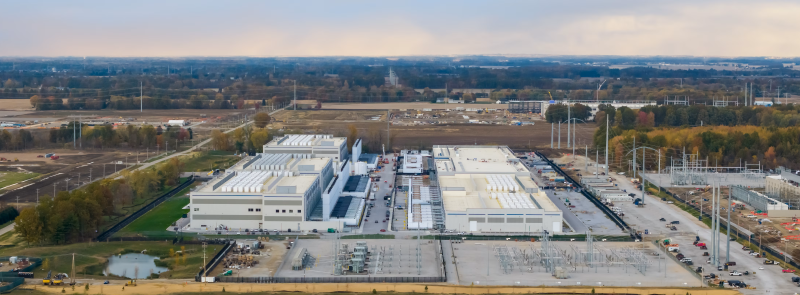
US data centers look to behind-the-meter power solutions to bridge the electricity infrastructure gap
Data centers are on track to significantly add to power demand in the US over the next 5 years. The amount of expansion alone by 2030 is equal to the current combined annual power consumption of New York and California. It’s the largest 5-year surge to the grid since the 1980s. That surge is especially notable when considered against the flat growth of electricity demand seen over the previous nearly two decades.
Data centers aren’t the sole drivers of this surge in electricity demand, but they’re the most significant near-term driver. They’re one of three converging forces, along with reshoring of advanced manufacturing and electrification. By 2030, total US electricity demand could grow by as much as 20 percent from 2025 levels.
The new crop of data centers have different power needs
The rise of artificial intelligence is changing the way data centers draw power, too. Traditional enterprise and cloud computing workloads tend to run at relatively stable utilization rates. Artificial intelligence has different modes with different power demand profiles; training, in which the AI is gathering knowledge and learning, and inference, in which the AI is using its knowledge to do a job. AI training clusters produce highly variable power load profiles with sharp ramps and dips at a megawatt scale and the workloads caused by inference fluctuate with user demand during the day. All data centers, whether running traditional enterprise or cloud computing or artificial intelligence require continuous, uninterrupted power availability.
Waiting for the power grid is costly
Adding the supply to meet so much electricity demand takes time. It can take 36 to 84 months for “power grid interconnection”. That timeline does not align with the typical data center build cycle of 12 to 24 months. Once constructed, operators can’t have the resources sitting idle.
In response, owners of hyperscale data centers are looking to other solutions, notably building their own “behind the meter” power supply and bypassing the power grid altogether, at least in the short term. These data center energy solutions aren’t a less expensive option, but they can close the time gap between construction and connection to the power grid.
To read more about the parallel energy system developing the US data center sector, including the mix of technologies deployed and the role of renewables, down the full paper.
Report Author
Amit Mathrani
Executive Director, Senior Energy Transition Specialist
Disclaimer
This publication is issued by Coöperatieve Rabobank U.A., registered in Amsterdam, The Netherlands, and/or any one or more of its affiliates and related bodies corporate (jointly and individually: “Rabobank”). Coöperatieve Rabobank U.A. is authorised and regulated by De Nederlandsche Bank and the Netherlands Authority for the Financial Markets. Rabobank London Branch is authorised by the Prudential Regulation Authority (“PRA”) and subject to regulation by the Financial Conduct Authority and limited regulation by the PRA. Details about the extent of our regulation by the PRA are available from us on request. Registered in England and Wales No. BR002630. An overview of all locations from where Rabobank issues research publications and the (other) relevant local regulators can be found here: https://www.rabobank.com/knowledge/raboresearch-locations
The information and opinions contained in this document are indicative and for discussion purposes only. No rights may be derived from any transactions described and/or commercial ideas contained in this document. This document is for information purposes only and is not, and should not be construed as, an offer, invitation or recommendation. This document shall not form the basis of, or cannot be relied upon in connection with, any contract or commitment by Rabobank to enter into any agreement or transaction. The contents of this publication are general in nature and do not take into account your personal objectives, financial situation or needs. The information in this document is not intended, and should not be understood, as an advice (including, without limitation, an advice within the meaning of article 1:1 and article 4:23 of the Dutch Financial Supervision Act). You should consider the appropriateness of the information and statements having regard to your specific circumstances and obtain financial, legal and/or tax advice as appropriate. This document is based on public information. The information and opinions contained in this document have been compiled or arrived at from sources believed to be reliable, but no representation or warranty, express or implied, is made as to their accuracy, completeness or correctness.
The information and statements herein are made in good faith and are only valid as at the date of publication of this document or marketing communication. Any opinions, forecasts or estimates herein constitute a judgement of Rabobank as at the date of this document, and there can be no assurance that future results or events will be consistent with any such opinions, forecasts or estimates. All opinions expressed in this document are subject to change without notice. To the extent permitted by law Rabobank does not accept any liability whatsoever for any loss or damage howsoever arising from any use of this document or its contents or otherwise arising in connection therewith.
This document may not be reproduced, distributed or published, in whole or in part, for any purpose, except with the prior written consent of Rabobank. The distribution of this document may be restricted by law in certain jurisdictions and recipients of this document should inform themselves about, and observe any such restrictions.
A summary of the methodologies used by Rabobank can be found on our website.
Coöperatieve Rabobank U.A., Croeselaan 18, 3521 CB Utrecht, The Netherlands. All rights reserved.